

Festive Tile Match Puzzle
Reviews
Festive Tile Match Puzzle takes the familiar tile-matching formula and adds one meaningful constraint: paths can turn at most twice. That single rule changes how you scan the board, because a visible pair is not always a clearable pair. The holiday theme and lack of time pressure make it approachable for families and casual players. The main limitation is that the input does not describe progression systems, level variety, or scoring, so the long-term challenge likely depends on board layouts rather than meta-progression. It is best suited for short, relaxed sessions.
About this game
How the Tile Grid Works
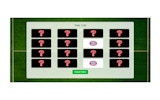
Festive Tile Match Puzzle presents a board filled with holiday-themed tiles. Your job is to find two identical tiles and connect them with a line that makes at most two turns. The path must be clear of other tiles. Once a valid connection is made, the pair disappears, and the board shrinks. The game ends when every tile has been cleared.
The Two-Turn Path Constraint
Most matching games let you pair any two identical tiles. Here, the path between them matters. A straight line works, a single turn works, and a path with two turns works. Three turns or more does not. This means you cannot simply spot a pair and tap it. You have to trace the route mentally, check for blocking tiles, and decide whether a longer path around obstacles is possible. That spatial reasoning is the core challenge.
Controls and Accessibility
Controls support both mouse and touchscreen. You select the first tile, then its matching counterpart. If the path is valid, the pair clears. The interface is designed for quick sessions, and full screen mode is available if you want a larger view of the board. No download is required, and the game runs in a browser.
Holiday Theme and Pace
The visual design uses cheerful holiday colors and festive tile artwork. The tone is relaxed rather than competitive. There are no timers mentioned, so you can plan each move without pressure. The difficulty comes from the board layout and the two-turn rule, not from speed. This makes it suitable for players who want a low-stress logic puzzle, including families and younger players.
Planning Your Moves
Before selecting a tile, scan for pairs that have a clear straight or one-turn path. Those are the safest clears because they are less likely to be blocked by other tiles. When the direct route is blocked, look for a two-turn path around the edges of the board. Clearing tiles from the outside inward can open new routes. Patience matters more than speed here, since the game is built for relaxation rather than rushing.








Comments
0 comments