
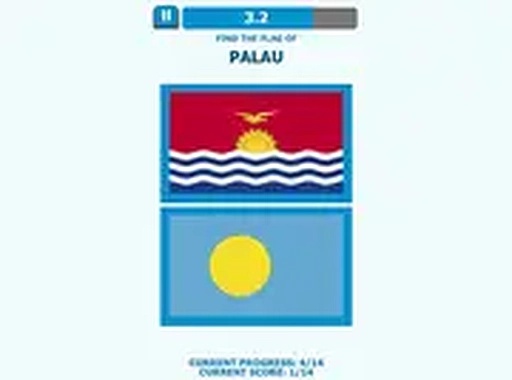
Pacific Islands Flag Challenge
Reviews
Pacific Islands Flag Challenge stands out for its clean design and patient pacing. Without timers or pressure, players can study each flag carefully, which makes it ideal for both quick review sessions and deep learning. The inclusion of smaller territories alongside major nations adds educational value. The full-screen mode is a thoughtful touch for distinguishing similar flags. While it lacks multiplayer or competitive features, its simplicity is a strength for those seeking a straightforward, effective study tool.
About this game
Flag Recognition Mechanics
Each round displays a single flag from a country or territory within Oceania. Below the flag, four country names appear as possible answers. Players click the name they believe corresponds to the flag shown. Correct selections reinforce visual memory, while incorrect answers provide a learning opportunity by revealing the right match. The game draws from a pool of flags representing Australia, New Zealand, Papua New Guinea, Fiji, Solomon Islands, and many smaller island nations. Because many flags in this region share similar color schemes—such as blue backgrounds with stars or crosses—the quiz emphasizes subtle differences in design, star counts, and emblem placement.
Self-Paced Learning Environment
There are no timers or pressure to answer quickly. Players can study each flag as long as they need before making a selection. This design suits both casual learners who want to browse and dedicated students aiming to memorize every flag. The interface remains clean and uncluttered, with only the flag and answer options visible. A progress tracker shows how many flags have been attempted and how many correct answers have been given, allowing players to monitor their improvement over multiple sessions.
Visual Clarity and Accessibility
Flags are displayed in high resolution to ensure small details—like the number of points on a star or the shade of blue—are clearly visible. A full-screen mode expands the flag to fill the browser window, which helps when distinguishing similar designs. The game works on desktop and laptop computers with a mouse or trackpad. No special software or plugins are required. Because the quiz runs entirely in a web browser, it loads quickly and works across different operating systems without installation.
Building Regional Geography Knowledge
Beyond flag identification, repeated play helps players become familiar with the names and locations of countries and territories across Oceania. The quiz covers independent nations as well as territories like French Polynesia, New Caledonia, and Guam. Over time, players naturally learn which flags belong to which political entities, building a mental map of the region. This makes the game useful for students preparing for geography exams, travelers planning trips to the Pacific, or anyone curious about world flags.
Practice Strategies for Better Recall
To improve accuracy, players can focus on one subregion at a time—for example, starting with Australian states and territories before moving to Melanesian or Polynesian flags. Paying attention to specific elements like the Union Jack in the corner of some flags or the number of stars on others helps distinguish similar designs. Repeating the quiz multiple times reinforces memory. The game does not shuffle flags randomly each session, so players can track which ones they have mastered and which need more practice.






Comments
0 comments